: TOLKIEN, John Ronald Reuel (1892-1973). Author of The Lord of the Rings.

Autographs & Manuscripts: Literature

Ref: AU4148

TOLKIEN, John Ronald Reuel (1892-1973). Author of The Lord of the Rings.

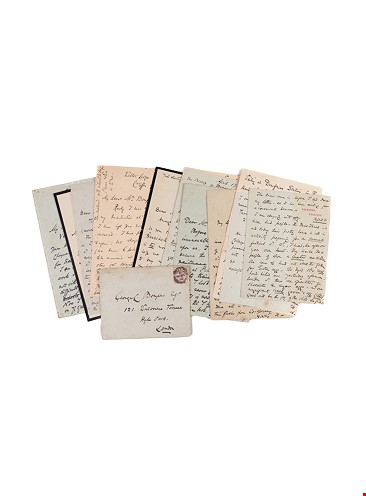
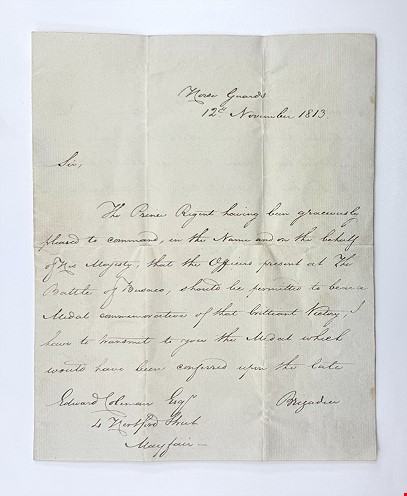
Autograph Letter Signed ("Uncle Ronald") to "My dear Jennifer" [Paxman] offering advice about Oxford colleges, and discussing misprints in The Hobbit, the development of Runes, and the various editions of The Hobbit.


A long and very detailed letter concerning "errors" in The Hobbit and giving an indication of the extreme care he took over both the chronology and the geography of his imaginary world, which he generally regarded as being quite as "real" as the real world, and also giving his views on various Oxford colleges.

"First to business. I certainly do not see why you should not get in to Oxford in 1949. You ought, of course, to try. Personally, I hope that things may be a bit easier by then. What is causing the crush is first of all the fact that before the war there was not really enough room, while now with only a small proportion of the room free (for people who are not ex-service of some sort) the scrimmage is frightful. My daughter is a bit more unlucky as being 18 (last June) she has to try now, and I am wondering what will happen. The whole organization of this institution being terribly democratic (since it is mediaeval in origin) is also immensely cumbrous, complicated, and slow-moving. For a while I was more or less what in younger institutions would be called head of the department of English, but only as an elected person: chairman of the faculty of English. Even so I had no control whatever over colleges, either in in their choice of dons or teachers, or in their acceptance of students, or in their standards. I am not even that now, merely the senior professor which is just nothing. So I would not cut even an ice-cream, if I tried to push you (or my daughter) through a gap in the fence: to mix the metaphors. Only in my own college could I try to exert an (sic) "patronage", and that would not go far.

However, I can give advice. And will when the time gets nearer. For one thing, I think, for you or anyone who is really keen to come to this uncomfortable place, the chief thing is to come and the exact college matters less. You ought to take the entrance-examinatios, as they occur, whether the "group" contains your favoured college or not. Also: have you any burning reason for picking Somerville? Apart from any private or family reasons for choice, I should myself have selected Lady Margaret Hall, at any rate for anyone reading English. However, that can wait. All the above is confidential. It would not do at all for it to be broadcast that officials should even think of "patronage", or that they should "back" any one college. Though, of course, I am often asked to choose. All I can say is that I want my daughter to go to L.M.H, if she can and failing that wherever she can get in [Tolkien's daughter, Priscilla, did eventually attend Lady Margaret Hall].

As for "the Hobbit". There are a fair number of errors in it, and though I keep on sending corrections in to Allen and Unwin they don't seem to get put right. I find them rather unbusinesslike. They made a good many errors to start with. The end-paper I I designed they put in as a picture to face p. 146 and the maps which are unsuitable and spoiled by it they used as end-papers. And they lost the corrected "moon-lather" runes for Thror's map; so that text and map don't correspond. For where p. 64 read when.

But the author also made errors. On p. 30 the text to agree with red runes should read "five feet high the door and three may walk abreast"

The chief error otherwise is on p. 35: the third or March a hundred years ago last Thursday. The part way [sic. Tolkien seems to mean 'The party was'] on a Wednesday (p. 17, 20). If this was true, therefore, the party must have been on March 9 and the expedition must have set out on March 10. But that was not so: it was just before May" (p. 40), and also it would only have taken about a month's slow going to reach the Trolls on 31st May (p.41). As Bilbo's birthday was Sept. 22nd and a Thursday that year, the party must actually have occurred on Wednesday April 27th. The text should read twenty-first of April/or/a hundred years ago last month. The latter is correct.

Other errors are clearly printing-errors like find for fine p.14 (l.17); under under for under p.85; being being = bering [?] p.85. But one annoys me, and that is back tops for black tops p.104.

Runes. The whole linguistic situation in "The Hobbit" has become rather complicated owing to the necessity for translation. The language of the time, or the Common Speech of the West, is represented by English. This particular variety of Dwarf came from the North where a more northerly language was locally spoken. Now Dwarves have their own secret language, but like Jews and Gypsis [sic] use the language of the country. So all these Dwarves have Norse dwarf-names, to represent the relations of the country and people of Dale (Bard the Bowman) etc to the Common Language. The Dwarves used a more inscriptional alphabet - and I am now rather sorry that I used instead the Anglo-Saxon Runes (on the translation principle). The dwarf-alphabet was much better. The Elvish Alphabets do not come into the Hobbit - unless you have the full English edn. with coloured pictures in which case you will see a bit of an inscription in an Elvish alphabet (the Alphabet of Fëonor) on the great jars in the left-foreground. This alphabet plays a considerable part in the sequel "The Lord of the Rings". I can let you have all these things, if you want them. They were not, of course, invented for The Hobbit or its sequel, since these things are only fragments torn out of "the Silmarillion" or the History of the Elves, which no one will publish.

As for the actual runes in the book and your questions. [P.P] stands for Thron son of Thrain. But that is an error that besides myself you alone have spotted. On p. 202, 3 the order is given as Thorin - Thror - Thrain. But even that was erroneous as dwarf-kings don't abdicate, and the "grandfather" was still alive when the map was made. In the sequel it will appear that the grandfather Thror was son of an older King Thrym (Thistlebeard). So that [P.P] stands for Thror Thryne's son. All these dwarf-names (except Thryn and Thistilbardi (Thirstlebeard), which is in another list) come out of the list of dwarf-names inserted into the Völwpa as "Prophecy of the Sibyl" that is the first poem of the Elder Edda.

The red runes actually read FIVE . FEET . HIGH . THE . DOR . AND . THREE . MAY . WOLK . ABREAST. The 20s (fr oo/a) are not "errors" but intentional "inaccuracies". The F in "and" is used as a throughout. The history is this: F=ansus "heathen god" was the original common germanic rune for A. But the runes were so bound up with their names that when the names changed the value of the letter tended to shift. (So [symbol] = opil 'home-land' = o, became in Anglo-Saxon e because opil became oepil>epel) ausus became in A.[nglo] S.[axon] os and so F became O, but the English altered their rune to three varieties to fit the need of their peculiar language. Most of their as had shifted to ae (that is what your x is an error for, I guess) the sound as in modern ash O.[ld] E.[nglish] aesc. So they kept F = ae calling it 'ash' - and so at my instigation in Oxford the ligature ae in A-S is now usually called [symbol]. [Symbol] with a tick they use for a. [Symbol] with two ticks for o. But in spelling out modern English one does not need a distinction between ae/a and I mostly used the simpler letter F in its original value a.

I must also apologize for my writing which deteriorates rapidly as a letter proceeds. But I hope some of this is legible. I knew about my Aunt Jane's proposed move. I was in Rottingdean for a night or two recently. I have only just, late last night, come back from a 500 mile journey inspecting farms and estates in Lincolnshire, Cambridge, and Leicestershire. And my head is dizzy with statistics, and machinery, and crops, and farmers of all sorts. I am sure that would amuse my aunt Jane mightily. But we have a curious assortment of jobs to do and "dons" are not in fact always quite what popular legend depicts. Of course it is no part of the job of a professor of English, but it is part of a fellow of Merton's task. In all my life I have only once before penetrated Lincolnshire (briefly and about 49 years ago). The experience was astonishing. I managed to spend a little while in the Minster, but I am afraid (there the donnishness comes out) my most pungent memory is of a card over the remains of the tomb of Little Saint Hugh (the supposed martyr) stating that his story was told by Chaucer in The Prior's Tale! Unless Lincoln is in Asia that can hardly be true, nor could the card have been written by anyone who had read the tale. And leading from that I am lost in wonder why you should have to write out the greater part of the Prologue (a much over-rated piece anyway, and inferior to Chaucer's best work). One wonders if people ever really get beyone the Prologue - so much that is said or written about that rather elusive bloke only applies to the Prologue (if to anything). Don't let the Geog. mistress get hold of this document! Though I refrain from saying what I personally feel about G. as a subject. I am sorry I have never seen you (though I have often heard of you all); and I have not seen your father for ages. But perhaps that may be amended . . . "
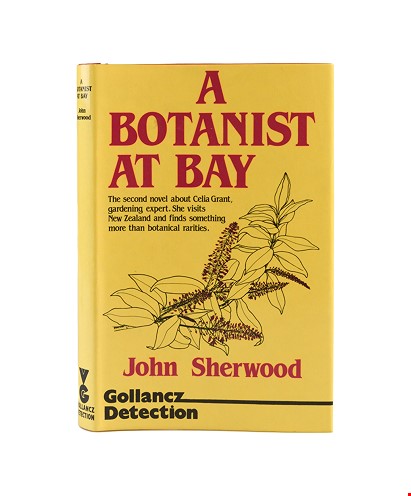
"As for the "bibliography" of the Hobbit. Have you, and now have got hold of an American edition, which is prohibited from sale in this country? In this country there are four. (1) the original with no plates (2) the 2nd with four (of five) (3) reprint with only [?] coloured frontispiece and (4) Foyle's Childrens Library with no maps and pictures that are in text. The American Edition is large, fat and has a coloured picture of the Eagle's Eyrie, but omits the coloured picture of Bilbo on the barrel."

Tolkien had his first experience of dealing with publishers and printers with The Hobbit, and it was not an entirely happy one. His own working methods were painstaking, and painfully slow, and over the years Allen & Unwin proved patient; however, anything other than perfection was bound to upset Tolkien. He continually revised and checked both the geography and the chronology of his mythical world - a process which was to lead to vast difficulties when applied to the considerably longer Lord of the Rings - and drew detailed maps in order to verify his own work. Humphrey Carpenter, in his biography of Tolkien, explains that " . . . his scheme of having the general map as an endpaper and Thror's map placing within the text of Chapter One was not followed. The publishers had decided that both maps should be used as endpapers, and in consequence his plan for 'invisible lettering', which would appear when Thror's map was held up to the light, had to be abandoned."

Tolkien's Aunt Jane, whose move he mentions, was his mother's younger sister. She lived for some years on a farm in Worcestershire, known locally as "Bag End", a name which was then used in The Hobbit.